TRANSLATOR PRO / SUPPORTED LANGUAGES
117 main languages and 339 total locales for multilingual game releases.
Translator Pro is designed around broad language coverage rather than a short market list. The language setup flow supports major global languages, regional variants, and a tiered confidence model that helps teams plan wider release coverage with clearer expectations.
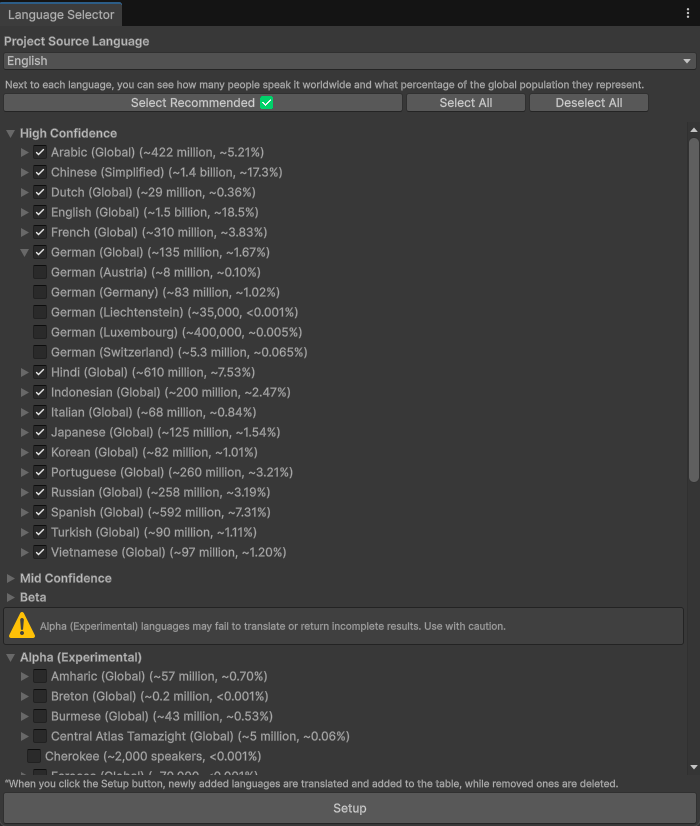
The language selector exposes global and regional variants, shows recommended picks, and organizes coverage by confidence tier so teams can balance release ambition with operational certainty.
How the coverage is structured
High-confidence languages
The interface groups the most dependable release languages together, making them easier to select for primary launch plans and repeatable production workflows.
Regional locale variants
Coverage is not limited to one label per language. Regional variants help teams localize more precisely for target markets when language, tone, or platform presentation differs by locale.
Experimental tiers
Beta and alpha groupings are surfaced in the selector so teams can consciously decide when to test broader reach without treating every locale as equally mature.
Representative language coverage shown in the workflow
Examples visible in the selector
- Arabic (Global)
- Chinese (Simplified)
- Dutch (Global)
- English (Global)
- French (Global)
- German with regional variants such as Austria, Germany, Liechtenstein, Luxembourg, and Switzerland
- Hindi (Global)
- Indonesian (Global)
- Italian (Global)
- Japanese (Global)
- Korean (Global)
- Portuguese (Global)
- Russian (Global)
- Spanish (Global)
- Turkish (Global)
- Vietnamese (Global)
Confidence tiers and release planning
What the tiers communicate
Translator Pro exposes high-confidence, mid-confidence, beta, and alpha groupings to help teams understand which languages are safest for primary release operations and which are better suited for staged expansion or experimental testing.
Examples from the experimental end
The alpha section shown in the workflow includes examples such as Amharic, Breton, Burmese, Central Atlas Tamazight, and Cherokee. That tells teams the tool is thinking beyond mainstream market lists while still warning that quality may vary.
Practical takeaway
For most teams, the value is not just the raw language count. It is the ability to start with strong primary-market coverage, then expand into regional or lower-confidence locales with better visibility into tradeoffs, review needs, and rollout pacing.
NEED HELP CHOOSING TARGET LOCALES?
We can help map language coverage to your launch plan.
If you are deciding between primary markets, long-tail locale coverage, or staged release tiers, we can help you choose a practical target-language mix for your project.